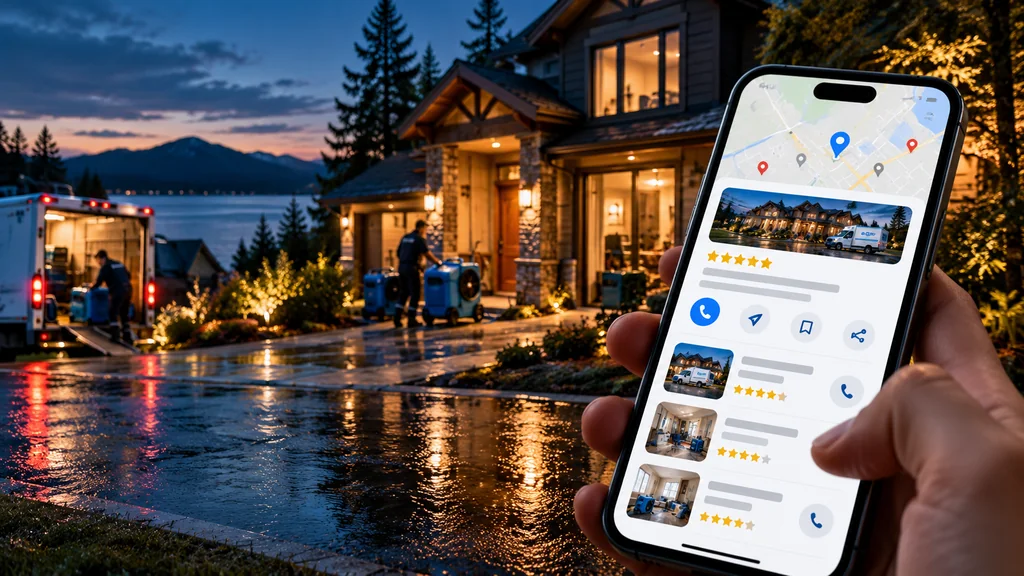
For a water damage company, the Google Business Profile is not just a directory listing.
It is often one of the first places a homeowner compares local options during an emergency.
The profile has to do three jobs at once:
- Help Google understand the business.
- Help the homeowner trust the business.
- Make it easy to call or take the next step.
Use this checklist to strengthen all three.
1. Verify the profile and use accurate business information
Start with the basics:
- verified ownership
- correct business name
- accurate address or service-area configuration
- correct phone number
- current website
- accurate hours
- accurate service areas
Do not add keywords to the business name unless they are genuinely part of the real-world business name.
Consistency matters. The company should be represented similarly across the website, major directories, social profiles, associations, and other public references.
2. Choose the most accurate primary category
The primary category is one of the strongest ways to tell Google what the business is.
For a company primarily focused on water losses, use the most accurate restoration category available for the actual business.
Then add legitimate secondary categories for services you truly provide.
Do not add unrelated categories just to appear for more searches. Relevance is more useful than category inflation.
3. Complete the service list
Add the services customers actually call about.
Depending on the company, that may include:
- emergency water extraction
- water damage restoration
- structural drying
- dehumidification
- burst pipe cleanup
- basement flooding
- appliance leak cleanup
- sewage cleanup
- mold remediation
- fire and smoke damage
- storm damage
- commercial water damage
Use plain customer language, not only industry terminology.
A homeowner is more likely to think “flooded basement” than “Category 3 mitigation protocol.”
4. Write a clear business description
The description should quickly establish:
- what you do
- where you work
- whether you provide emergency response
- what makes the company credible
Avoid hype that cannot be substantiated.
Do not stuff the description with every city and keyword you can think of.
5. Keep hours and emergency availability accurate
If the company genuinely answers 24/7, the profile should reflect that.
If it does not, do not claim it does.
A profile that says “open” while every call goes unanswered creates a conversion problem, not an advantage.
6. Add real restoration photos
Use real proof whenever possible:
- trucks
- technicians
- drying equipment
- containment
- job sites
- before/after documentation where appropriate
- office / facility
- team
- equipment
Generic stock photos do not build the same trust as recognizable evidence of a real local restoration operation.
Create a simple monthly rhythm for adding new photos.
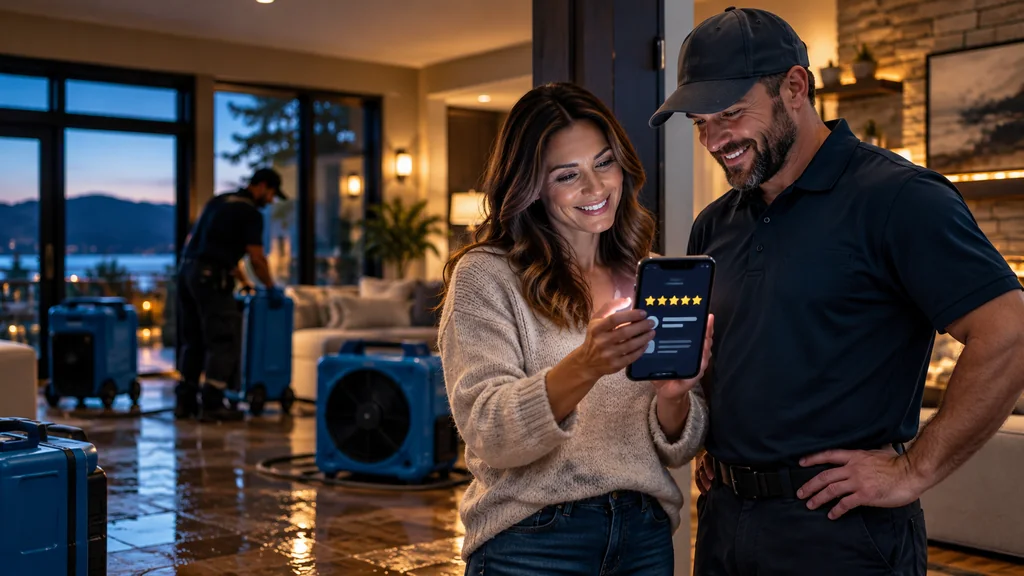
7. Build a legitimate review-generation process
Google reviews influence both trust and local visibility.
Google's public guidance notes that review count and positive ratings can contribute to prominence in local results.
But the process has to be legitimate.
Do:
- ask real customers for honest feedback
- make the review link easy to access
- follow up consistently
- monitor new reviews
- respond professionally
- learn from negative feedback
Do not:
- buy reviews
- offer incentives for reviews
- pressure customers to write specific content
- selectively solicit only positive reviews
- discourage negative reviews
Google explicitly treats those behaviors as rating manipulation or fake engagement.
8. Respond to reviews like the next customer is reading
The response is not only for the reviewer.
It is also for the next homeowner comparing companies.
A strong response:
- acknowledges the customer
- stays professional
- avoids revealing private job details
- demonstrates responsiveness
- reflects the company's real tone
For negative reviews, do not argue in public. Move the operational resolution into a direct conversation when appropriate.
9. Keep the website and profile aligned
The website should reinforce the services and locations represented in the profile.
If water damage is the primary service, the site should have a strong water-damage page.
If the company serves multiple locations, the site architecture should make those service areas clear without mass-producing thin pages.
This alignment helps humans and search systems understand the business more clearly.
10. Track the competitive gap
Do not optimize the profile in isolation.
Compare it against the companies that are actually winning the local results.
Look at:
- primary category
- review count
- review recency
- rating
- photos
- services
- website strength
- local authority
- service-area coverage
- overall prominence
The goal is not to copy the competitor.
It is to understand why the market may trust or surface them more often.
11. Measure calls and real opportunities
Profile activity is useful, but the business ultimately needs qualified restoration work.
Track as much of the path as you reasonably can:
Profile / search -> call or site visit -> qualified opportunity -> booked job -> revenue.
That turns profile optimization from a cosmetic project into an operating asset.
12. Audit the profile monthly
A practical monthly GBP routine can include:
- check business information
- check hours
- check category/service changes
- review new customer feedback
- respond to reviews
- add real photos
- review calls / conversions
- compare visibility against competitors
- check for profile edits or issues
The exact cadence matters less than consistency.
FAQ
What determines Google Maps rankings?
Google publicly says local ranking is mainly based on relevance, distance, and prominence. You cannot control the searcher's distance, but you can improve the accuracy, relevance, authority, reviews, and overall prominence of the business.
Do reviews help a restoration company rank?
Google states that more reviews and positive ratings can help local ranking. Reviews also help conversion because emergency customers use them to judge trust quickly.
Should I put city names in my Google Business Profile name?
Only if they are part of the legitimate real-world business name. Keyword stuffing can create policy and suspension risk.
How many service areas should I add?
Use the areas you genuinely serve. Do not treat the service-area field as a keyword list.
Know whether the profile is actually the problem
Sometimes the GBP is the bottleneck. Sometimes the bigger issue is website authority, AI visibility, reviews, citations, paid media, conversion, or a competitor with a much stronger local footprint.
A Restoration Market Gap Report helps identify the actual gap before you spend months fixing the wrong thing.
Source notes: Google Business Profile Help - “Tips to improve your local ranking on Google” and Google's prohibited/restricted content guidance for reviews.
Written by Isaac Voss